#168 - Kayaking 315 Miles Down Florida’s St. Johns River with Daniel Robison


 Apple Podcasts

 Spotify

 Overcast

 Castro

 PocketCasts

 RSS Feed
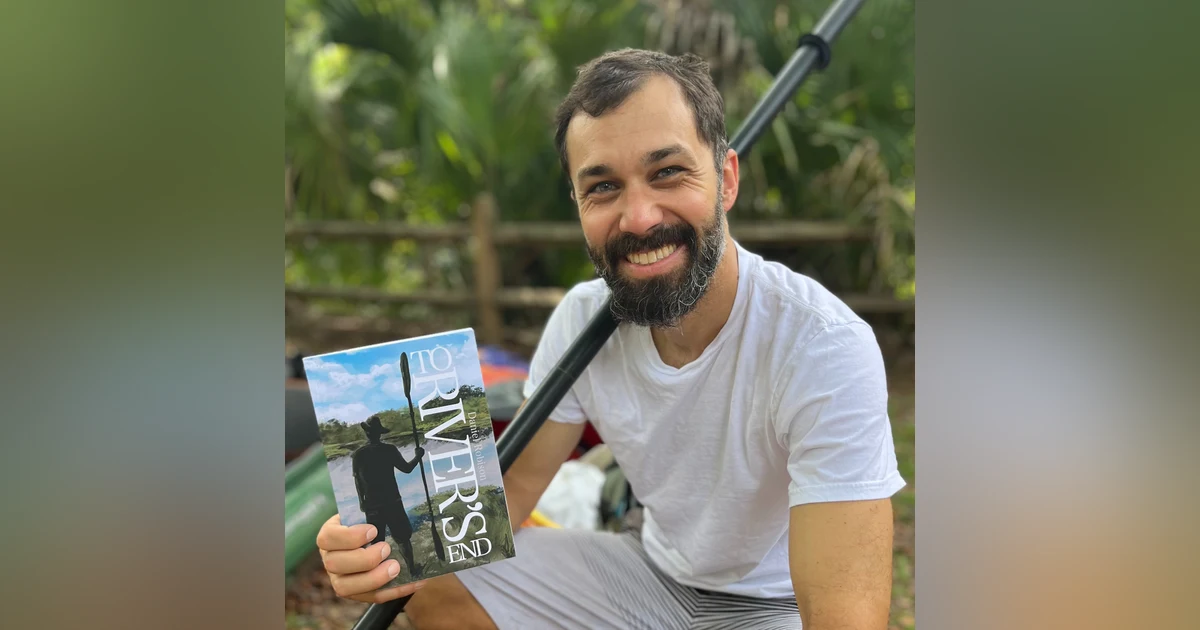
Daniel Robison recounts his lifelong love of paddling and his expedition to paddle all 315 miles of Florida’s St. Johns River. Join us as we talk about changing ecosystems from swamp to brackish estuary, close encounters with wildlife including alligators and manatees, and the challenges of navigating shallow canals and wide lakes.
To Rivers End by Daniel Robison
0:02 Welcome to Paddling the Blue. With each episode, we talk with guests from the Great Lakes and around the globe who are doing cool things related to sea kayaking. I'm your host, my name is John Chase, and let's get started paddling the blue. Welcome to today's episode of the Paddling the Blue podcast. Daniel Robison started a fascination with Florida's St. John's River at age 15. So join us today as we talk about Daniel's journey of discovery to paddle all 315 miles of a river where the local wildlife is trying to eat you as you experience areas of great biodiversity. Before we get to today's conversation with Daniel, James Stevenson and Simon Osborne at OnlineSeaKyaking.com continue to produce great content to help you evolve as a paddler and as a coach.
0:43 You'll find everything from basic strokes and safety to paddling in tides, surfing, coaching, documentaries, expedition skills and incident management, and more. So if you're not already a subscriber to OnlineSeaKyking.com. Here's your opportunity to get started. Visit OnlineSeaKyking.com, use the coupon code PTBpodcast to check out, and you'll get 10% off just for being a member of the Paddling the Blue community. And while you're there, be sure to visit the community section where you'll find an interview with me. So thanks to Simon and Daniel for hosting me on their meetup. For those of us who also enjoy paddling whitewater boats, be sure to check out onlinewhitewater.com, their sister company, while they're offering the same discount to listeners. Use the coupon code, once again, PTBpodcast to check out and explore.
1:28 And I'd love to help you put those skills to work. I offer a wide range of programs in the Great Lakes and beyond from paddling skill development, instructor certifications, workshops, CPR and wilderness first aid, guided trips, and more. So visit paddlingtheblue.com, Click the Courses and Trips link at the top of the page, and I hope to see you on the water. Enjoy today's interview with Daniel Robison. Hey Daniel, welcome to Paddling the Blue. John, thanks so much for having me. Yeah, so thanks for reaching out. You reach out to me, and we're here to talk a little bit about the St. John's River and your attempt on the St. John's River and how that went for you. But first, let's start with a little bit about how did you get your start as a paddler? So my love with paddling started when I was 15 years old.
2:13 Before that, I'd really never even been out on the water period. And for my 15th birthday, an old family friend, she had a house out on the Little Wekiva River. It's a river down here by us that flows into the St. John's River. And she had just a ton of kayaks and canoes she was just kind of like a river rat and i got in a canoe and it was just kind of over for me i mean it just something clicked, and just that feeling of being in the water especially just like paddle powered craft not just you know a motorboat but but actually a kayak canoe i just fell in love with it just.
2:54 That day and ever since then have just absolutely loved being on the water. So after that point, um, I was going over to her house all the time. I made a, made a bunch of friends with, with people who love kayaking and we've just been out on the water ever since. Well, that's cool. Now curiosity. So you live in Florida. Yes. All right. And, uh, what's the farthest one can be from the ocean in Florida? Oh man, not, not far, Yeah. Maybe an hour and a half? Yeah. Yeah, probably. So an hour and a half from any place in Florida, you can get to the ocean. Yet you'd hardly ever been on the water until age 15. Right. Well, I mean, you know, I, I'd gone, you know, body surfing and stuff and I pulled out a surfboard every once in a while when we go to the beach, but, but being a kayak, a canoe, that was just something I, my family just didn't do that. Okay.
3:46 All right. So just a different type, different way of getting into the water that is. Yes, definitely. Yeah. I definitely had been in the water before, but, but kayaking, canoeing just had not been exposed to it. Okay. All right. So now where did that lead you, uh, between 15 and your St. John's river trip? Yep. So, like I said, I made a bunch of friends with guys who were interested in kayaking, canoeing, and I started thinking, man, let's go on some big trips. Let's try to go for 30 miles. Let's go for 40 miles. Let's go for 60 miles. And I know some of the people on your show, I mean, they're like circumnavigating continents. So a few hundred miles is not even really that big of a deal in the broad scheme of things.
4:31 But for us, starting as teenagers and then into my early 20s. It was just this magical experience. The St. John's River is such a gem of Florida. It goes through pretty much, every environment that Florida has, you go from swamp to oak hammocks, then eventually up to, you know, coastal brackish stuff. So you just see all of Florida's environments as you go through it. And there's so much of it that's still, even to this day, undeveloped. And so we just started exploring. There's just so many places to go. And so after that time, when I was 15, we just kept going for longer and longer trips.
5:14 We would just go into the pantry, grab cans of chili and throw in maybe an extra pair of clothes in a dry bag. And we'd just be out for two days, three days, four days, just exploring. We'd print out some old satellite maps and say, maybe about here and just go and check it out. So for years, we were just kind of going all over the place, all right and was a lot of this on the saint john's river and then it's a lot of this was on the saint john's river and and other rivers that flow into it okay so just kind of exploring all those different places, right all right so tell us you started getting into some of the the biodiversity so tell us a little bit about what makes this river unique.
5:56 The St. John's River, with the biodiversity, being able to start in basically, at the southern part, it's basically jungle. I mean, it's, you know, vines, trees overhanging, you know, you've got these tropical birds flying around. Obviously, tons of alligators, that's always really intriguing to people that there's alligators down here. Very big alligators. So so you start in in almost like a jungle and the first part of the saint john's has actually been directed through these different man-made canals now, it's it's not natural in the first part and so it's this very surreal experience you start in this you know kind of misty swamp and but it's these perfectly straight canals kind of going on as far as you can see and then it eventually gets into you know marshland then you're up into higher ground pine and oak hammock.
6:48 And, like I said, eventually into brackish water so you get more of a coastal, so you can smell the salt. And so it's such a unique river in that because it flows that north to south direction, you're going a very large swath of Florida is cutting through. And so if you go any amount of time on the St. John's, you're going to see a huge diversity in the landscape. And so it's really hard to get bored going on the St. John's. Every place is going to look very different. And you said, does it flow from the south to the north? It flows north, yes. Only a few rivers in the world that do that. Okay. And so we're talking 310 miles long.
7:31 And I hear it's been referred to as the world's laziest river. That's correct. Yeah, I mean, Florida, you only got but a few feet in elevation from the southern tip to the northern tip. So there's very little grade for it to flow. So it's very slow. Usually on some of our trips, the current wise, it's very slow. But then during certain storms, just because of the way that the it's very narrow for a lot of the way. Maybe two-thirds of the way it's very narrow i mean a lot of high trees on the side so the wind can really funnel through it and so if you get in storms current wise it's very slow but but the wind can really funnel through and either, i mean i guess that could be a good thing if it's at your back but if it's in your face it could be pretty pretty tough paddling sure sure now you the way you described it you have some really narrow and the canals and you know jungle like at the start but it it ends up widening out right yes yes there's a really big, lake well it's big for us in florida lake lake george and it's, a rough a rough halfway point and after that it it gradually starts to get bigger and bigger until i think up by jacksonville it's close to two or three miles across so it's it's pretty wide but before that.
8:51 It's, I mean, there were some places when we went, when we did our entire trip, the water was extremely low, but there were some points when you could almost straddle both banks, just put one foot on each bank and you're just barely squeezing through way down south. So there's a huge variation and very shallow down south. So yeah, not only are you moving through different environments of the landscape, but the water itself you go from from very small winding, river to this gargantuan thing closer up to jacksonville and also very uh lots of houses lots of boat traffic as you get closer up to jacksonville whereas down south i mean you could go all day and not see anybody okay, so world's laziest river drops 27 feet over 310 miles so about an inch per mile yep uh.
9:41 Wide in some spots very narrow You can straddle it in other spots, anywhere from straddling to two miles wide. And the depth, I guess, is not very deep on average as well, like 11 feet, something like that. Yeah. Yeah, a lot of it's very shallow. Okay. Even a lot of the lakes are very shallow. Okay. And then you mentioned wildlife. Alligators. Let's talk alligators. I hear a lot of alligators. A lot of alligators. It doesn't bother us too much. I'm a Florida native, so I've grown up with alligators. People from other parts of the country freak out about the alligators. They are very big down south. Some of the ones that we saw on our trip, they'll get 17, 18 feet, gigantic alligators.
10:27 Generally, they don't bother you. The biggest danger is an accident. Not that they're coming to get you, but sometimes they'll almost be sunning themselves in the water, but just slightly under the surface and just kind of hanging out there. And you cannot even see them and your boat can go right across them, sort of rub against them and spook them. And just the sheer power of them. I actually knew a guy who did that. And just in a split second, the gator flailed up the tail on one side of his kayak, the head on the other. And within a split second, his boat just snapped right down the middle. And he just found himself sitting in the water and the alligator took off.
11:09 I mean, he didn't want anything to do with them, but just the sheer power of these guys, that's where the real danger is. And we really had to be careful. Yeah. I'm not sure that I want to paddle with anything 17 to 19 foot long that, It looks like a dinosaur and it can eat people. Well, so I went, so I did this trip when I was 23 and my buddy David, who did the first half with me, he was even younger. I think he was maybe 19 or 20 at the time. And so, you know, we're just 23, you're invincible. You don't, there's so many things you don't think about. Sure. And, and when we ended up going, I mean, we didn't even realize that it's kind of getting close to alligator mating season.
11:50 And there was, there was a lot of, I mean, I think we counted over a thousand gators and, uh, and most of that was just in the first five days when we were down South and you would. You know, turn a bend and you'd see 30 alligators sunning themselves on the banks, big ones. And when gators get spooked, they run to the water because they're faster in the water. But the problem is, you know, you're in a channel that's only, you know, 20 feet across, who knows how many feet deep. And these 30 alligators just go and plunge in this water that you're just about to go through. And so there was a lot of gators in the water. So So our biggest concern wasn't that they were going to actively attack, but just with that many of them in there, you got to be pretty, pretty cautious. Sure.
12:36 And I like how you qualify it. Generally, they're not a problem. Yeah, generally. So what other kind of wildlife do you get to encounter in the St. John's? We got, I mean, obviously a lot of birds. You got great blue herons, snowy egret, tricolor heron, night herons. You got owls, hawks, a lot of manatees. Every once in a while you see some otters or a, and what are those things called? A nutrias. Nutrias. Every once in a while we'll see some of those. What's a nutria? It's like a, it's the weirdest thing. I didn't see one until I was in my early twenties. It looks like a beaver. It's like the size of a beaver with the tail of a rat.
13:19 Very bizarre. Yeah. Yeah. I have to look it up after. It's the, it's the weirdest thing. It'll make you do a double take you think oh it's it's an otter and then you're like no it's not an otter a little too fat for an otter and yeah it's it's really weird but it's huge it's just giant huge water rat now do they so they live in the water. Okay yeah they're really good swimmers all right i will check that out and i'll get a link in the show notes for folks people to check out her nutria, So tell me about the manatees. I've never paddled with manatees, and people talk about them and how beautiful they are. So let's hear about the manatees. Yeah, they're kind of like big underwater cows.
13:59 They're massive, and they're very curious. So there's a big thing in Florida. For a while, there were so many manatees that were getting chopped up by speedboat propellers and getting very injured. And so, you know, there's tons of no wake zones everywhere and they really made a big effort. We need to really watch out for these things because they're not exactly fast. And fortunately, the numbers have come back a lot. They really are. It's hard to stay away from them because they like to come to you. They're very curious, especially when it's kayaks or canoes, something that's not making a lot of noise.
14:40 They'll come right up to you and just check you out. The little babies want to see what's going on, but pretty regular site if you're going on the St. John's River and especially in the tributaries of the St. John's. Tons of manatees around there. I've seen some, sometimes, I mean, these things are hundreds and hundreds of pounds, but I've seen them sometimes like halfway out of the water. I don't even know how they've gotten up there, but they just sort of flail themselves up on the shore to get some kind of tasty plant or something that they see. But yeah, just kind of gentle giants. Very cool. We live close to Blue Springs, which is kind of known the world over as this manatee congregation spot.
15:23 And so in the winter, when the waters get colder in the St. John's River, they go up into Blue Springs, which flows into the St. John's and that water stays at a constant, I think it's 73, 72 degrees because it's spring fed and you'll get so many manatees, you can't even see the bottom of the riverbed. And so people will come from all over the world to see all the manatees, just hundreds and hundreds of them that hang out in there for the winter. Oh, that's cool. Yeah, very cool. All right. So we've gone from alligators that are trying to eat you, or maybe not, generally they're okay, to giant water cows. And then in between, we've got sharks. Yeah.
16:05 You know, I did not see any sharks. There are sharks farther up. Some people have said they've seen bull sharks as far down as where I'm at in central Florida. So about halfway down the St. John's where it's not even brackish anymore. But people have reported bull sharks down here. As you get farther north, definitely see some sharks. Some people do. I've never seen one. I do see a lot of dolphins when I go up in that area, though. Tons of dolphins in the in the river maybe even even lower than jacksonville, i've seen them now how far is the the brackish water, I think, I think it's around Palatka that it really starts getting, that's when I started noticing any, anyway, when I went there on my trip, that's when I really started noticing, okay, there's, you got barnacles growing.
16:57 You can kind of get that salty smell when the, when the wind blows over the water. So there's some, somewhere around there. So it's a little, little South of Jacksonville. And then that even changes with, you know, the tides with, if the tides coming in, it can kind of come up the river a little more when it's going out. The flow of the river can sort of push that back. So it's a little bit of a hazy line there. Okay. And just for our listeners who aren't familiar with the locations about how far up the river is that? If I had to guess, I'd probably say maybe 75, 50, 75 miles. Okay. That's quite a ways then. Yeah. Yeah. I mean, I mean, I guess maybe because the current is so weak that maybe it allows for that intrusion pretty far up. Okay.
17:45 And so you can see dolphins quite a ways inland then. Mm-hmm. That's pretty cool. Yeah, it is. So then you decide, you know, from age 15, you develop this love affair with the water and with the St. John's River. And then you decide someday that you're going to paddle the whole thing. So let's tell us a little bit about how you got to that point. So, we had done, like I said, kind of longer and longer trips and just seeing, you know, how far could we really go? And for years, we had kind of, at first, jokingly, but after a while, seriously considering, you know, could, is it even possible to do this? And you know obviously there was 2009 there was internet but it's not like it was today but it wasn't, you know there weren't just any and every kind of group doing you know whatever you might want to do online where you can just find this huge group of people who love canoeing and who have done this and that it just didn't really have the the information for that and so we were just kind of speculating on our own is it possible we'd never heard of anyone doing it, We didn't know anyone that was considering doing it.
18:52 And so we knew down south that some of the channels were confined to man-made canals. And so we're saying, you know, is it even possible to get through those? We knew a lot about...